



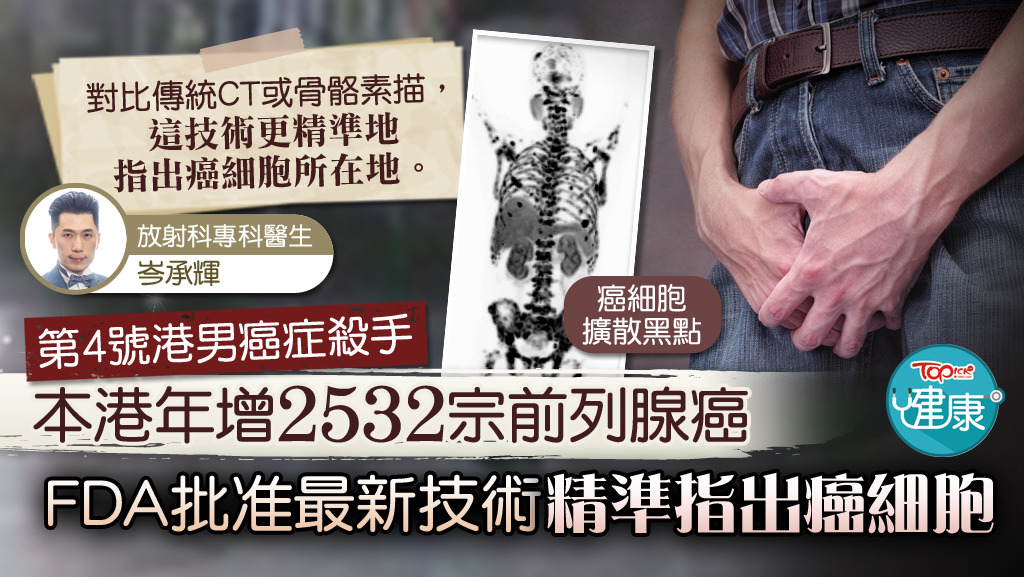
In December 2020, the U.S. Food and Drug Administration (FDA) announced that positron emission tomography (PET CT or PET MRI) targeting prostate-specific membrane antigen (PSMA) is suitable for cases of suspected prostate cancer recurrence or metastasis. Among them, the Gallium 68 PSMA-11 tracer has passed clinical testing. In May 2021, the FDA approved the use of another F18 PSMA tracer in prostate cancer patients with suspected recurrence or metastasis. Compared with traditional computer imaging (CT) or bone scan, this technology can pinpoint the location of cancer cells more accurately.
Prostate-specific membrane antigen (PSMA) is overexpressed on the surface of prostate cancer cells. Of course, this may also occur in lymph, bone and lung tissue where prostate cancer metastasizes. The signal of the short-lived radionuclide on the tracer will be received by PET CT Scan or PET MRI Scan , and finally the location of prostate cancer recurrence and its spread tissue will be displayed on the image. Therefore, if a patient is determined to have prostate cancer and is clinically judged to have a high risk of metastasis, PSMA PET can be considered to determine whether there is cancer metastasis. This information directly affects the direction of treatment.
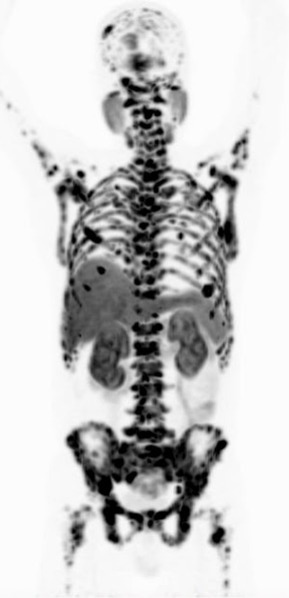
▲ The small black spots on the iliac bones are where prostate cancer cells have spread. (provided by the author)
As for prostate cancer patients, the prostate-specific antigen (PSA) in the blood should drop to undetectable levels after prostatectomy. Once the PSA level rises to a certain value, it is defined as biochemical recurrence. At this time, we can also use PSMA PET to detect the location of recurrence and its spread. Prostate cancer patients who have received radiotherapy can also use this method to detect the location of cancer recurrence and spread, thereby formulating a blueprint for treatment.
Does this sketch apply to every prostate cancer patient? Of course not. Men with prostate cancer who have a Gleason score of less than 6 do not qualify for this profile because their risk of spread is very low.

▲ Radiology Specialist Dr. Shum Sing Fai, John
Original link:https://bit.ly/3B7ZqJM